Before coming here, I knew having both running water and electricity were slim. I have electricity, but no running water. I didn’t have electricity during my first month, which was challenging, especially when the sun sets everyday at 6:30p.
Water is another problem. As volunteers, we’re always so curious to know what other people’s “water situations” are. Who has a spigot? Is it in their house? Outside? In the village? The lucky ones have one in their house, the not so lucky ones have to walk up/down a hill to fetch water or hire someone to get it for them.
Like the locals here, I use jerry cans to transport and store my water. They can hold 20L and weigh 44 lbs when full. It’s physically exhausting to transport water to my house, but luckily, the spigot is only 50m meters away and downhill when walking back home.
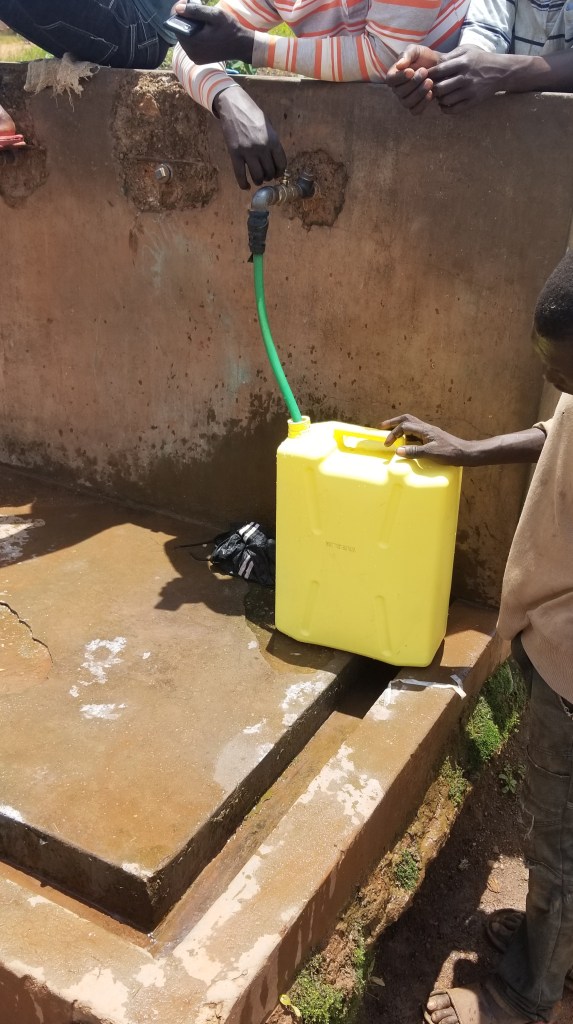
So, how much does water cost here? It depends on where you live in Rwanda. Some of my friends have to pay 100-200 RWF for a full jerry can, which is roughly $.10 – .20 USD. However, when it’s the dry season it can get up to 1000 RWF (~$1 USD). I think I lucked out, because mine is only 30 RWF per can, which is only $.30. My dad joked that he’d cover my monthly water bill by sending me $3.00, which would get me 10 jerry cans!
Though the water is cheap through our American lens, it can be quite expensive for Rwandan families. Before coming here, we were told that cleanliness and hygiene is one of the most valued aspects of the culture. I never understood why until I went into the village life where I can see how water insecurity separates social classes. When water was scarce, I sacrificed my personal hygiene. I didn’t wash my clothes, I didn’t shower every day, and you could tell. I was disgusting. Not having a reliable source of water, especially during the dry season, took a huge psychological toll on me. I’m not religious, but I would pray for rain so I could collect rainwater off of my roof. I often find myself stressing out about how to ration it – do I wash dishes, clean my clothes/shoes, wash my hands, brush my teeth, shower? I never thought I’d sacrifice hygiene to the extent that I have, but here we are. Without a second thought, I prioritized my water to drink and cook. I even starting thinking of ways to change my lifestyle so I would use less water, for example, I tried finding ways to make food that required the least amount of dishes to wash, working out less so I wouldn’t have to shower, eating from the pan so I wouldn’t have to wash a plate, etc. On top of all of that, I’d recycle the water I used to do laundry and wash my dishes and vegetables with so I can flush my toilet. (I have a flushing toilet, but no running water).
I can see how water scarcity affects the families here – their clothes and shoes are dirty and smelly. They don’t have good hygiene. Having access to water is one of the most defining determinants of social class. The huge emphasis on cleanliness is a result of that.
 Rwandering around with Joanna