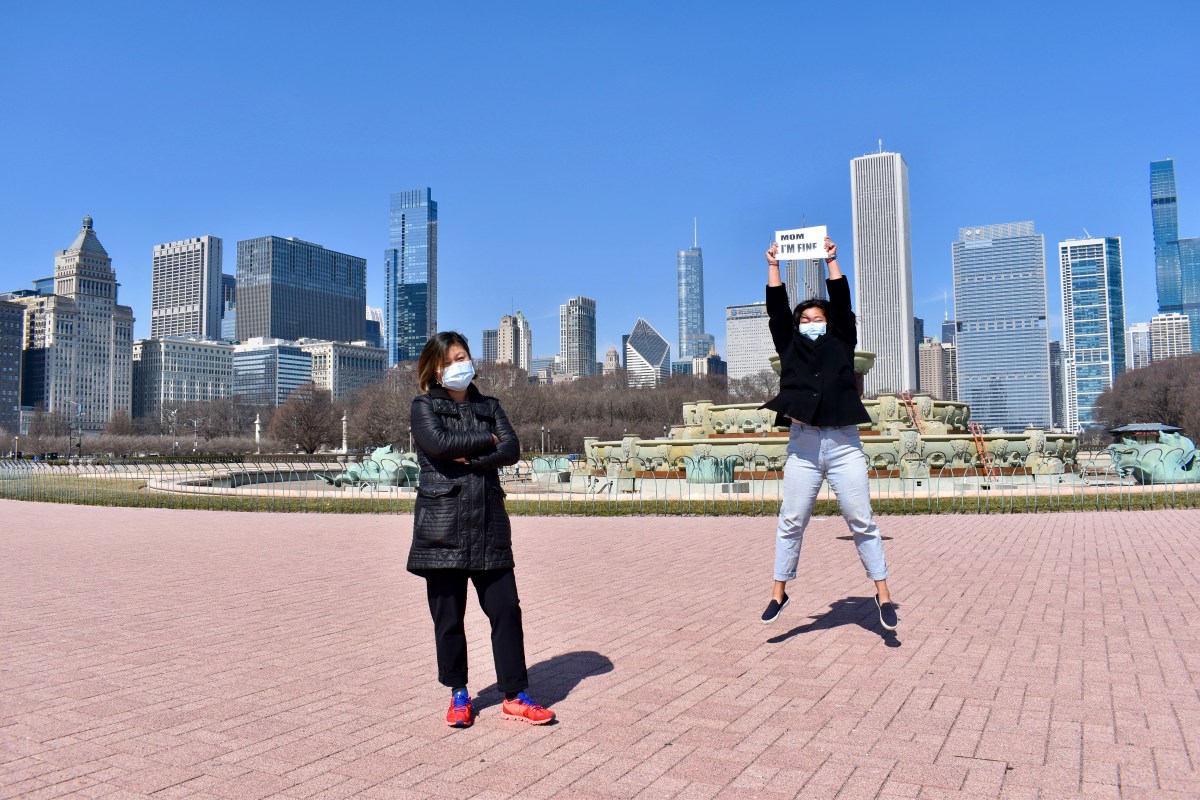
I’m back home. My mom and I took advantage of the beautiful weather and went for walk (6 feet apart). I couldn’t resist the opportunity to take this photo of us (notice the social distancing and masks).
This isn’t the way I wanted to come back home or the way I wanted to leave Rwanda, but here we are. It’s not the way I had imagined my arrival. In my mind, I would’ve been embraced by my parents at the airport, sharing a car ride full of two years worth of happy chatter on our way back home. Instead, I arrived to an empty airport with a text from my parents instructing me to take an Uber to an Airbnb. The cold weather didn’t help with the warm welcome.
Tough, but bibaho, it happens.
So now that I’m back, what’s next?
This is a great question. All of the volunteers who are back are forced to confront the reality that we came home much sooner than expected without anything planned. We left our lives back in our country of service – our homes, jobs, etc.
A lot of people have been asking if I plan on going back. Though reinstatement is possible, and has been done before, nobody knows the timeline. It could be anywhere between 2-6 months before going back and that’s a long time to wait for the possibility of it happening. Peace Corps is in uncharted territory – all programs are suspended. It took so much time and emotional energy preparing to leave and even more when we were being evacuated, I don’t know if I want or could do it again.
I had an amazing time doing the Peace Corps in Rwanda, and I’ll always remember it fondly. I learned an incredible amount about the culture, food, people, language and so much more. As I sit here reflecting on my past 6 months, one moment stands out from the very beginning.
In our first week of training, Jody Olsen, the Peace Corps Director came to Rwanda and told us what she gained from her service. She said by doing the Peace Corps, she gave herself away in order to find herself again. That’s exactly how I feel, I gave myself away and found myself again (cheesy, I know). I’m leaving with more clarity and direction than when I started, which exactly what I had hoped to gain from this. I feel ready to tackle the “real world” and I don’t know if I was six months ago.
It’s unfortunate that my service ended abruptly, prematurely, and unexpectedly, but I’m at peace with it. I left in a better place than where I started. As always, thank you for tagging along. Being able to write about and share my experiences with you has been an absolute joy.
This week has been non-stop because all Peace Corps countries are being evacuated due to the COVID-19 pandemic. It looks like my Peace Corps service is coming to an abrupt end. Early Monday (3.16.20) morning, we got an email from our Country Director that Peace Corps Washington DC is ordering that all countries must evacuate their volunteers. As I am writing this concluding entry, I want to ensure you that I am safe in Washington D.C. and will be on a flight to Chicago tomorrow morning.
Though they evacuated three countries in West Africa in 2014 because of Ebola, this is the first time in program history when everyone is being evacuated. Some countries were already in the process of evacuation before it came from Peace Corps Washington, but now it’s mandatory.
The straw that broke the camel’s back was South Africa closing its borders. South Africa is where all volunteers in the continent would get sent to in medical emergencies. Since their borders are closed, we would have nowhere to go in case of an emergency, thus putting us in more danger. Out of the 7,000 volunteers serving world wide, 46% of us are in Africa.
Rwanda also had its first confirmed case four days ago, on March 13, but it will spread very quickly despite the proactive measures the government has installed. From a public health perspective, COVID-19 will spread incredibly quickly in Rwanda because it’s the size of Rhode Island and has over 12 million people, making it the most densely populated country in Africa. The government understands this threat and has, quite literally, shut everything down within 24 hrs. All social gatherings were discouraged – no weddings, church, funerals, concerts, and schools were closed. Stores, restaurants, and markets have hand-washing stations in front of their entrances and a security guard who ensured that everyone used it. This all happened within 24 hrs of Rwanda confirming its first case.
It’s quite shocking how differently the Rwandan people have been acting since the first confirmed case. Before March 13, everyone was very relaxed about COVID-19, but once we had our first confirmed case, everyone started to take it more seriously and began treating me differently.
To them, I am Chinese, while my American identity is secondary and my Korean one is invisible. The amount of staring, COVID-19 comments, and racism has skyrocketed. But it’s not only Asians, any “umuzungu” or foreigner is being accused of having the virus and spreading it. My friend, who is a white, blond haired, and blue eyed male had an entire row on the bus to himself because nobody wanted to sit next to him. Any other time, people approach him and want to be his friend because he’s an American, but now people avoid him.
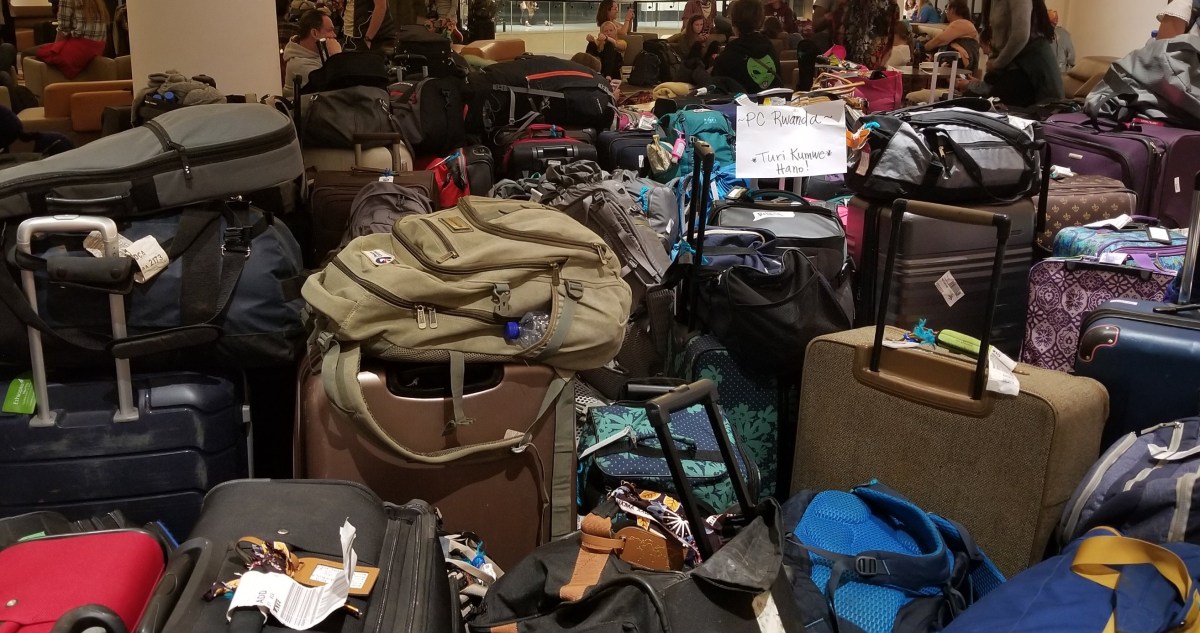
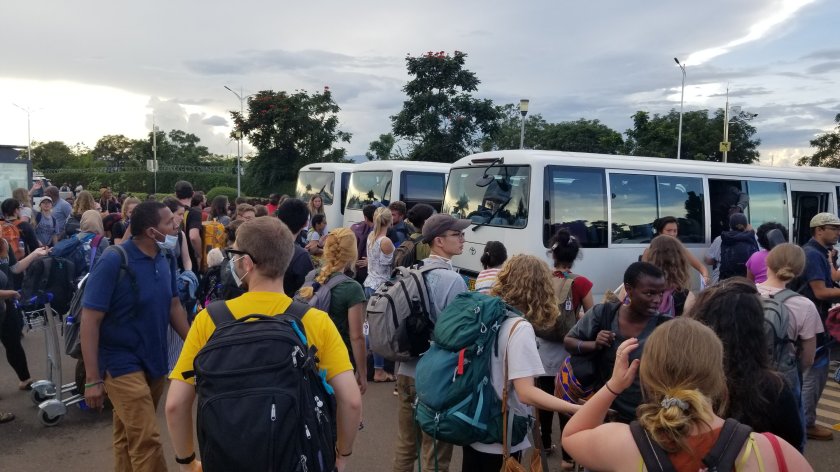
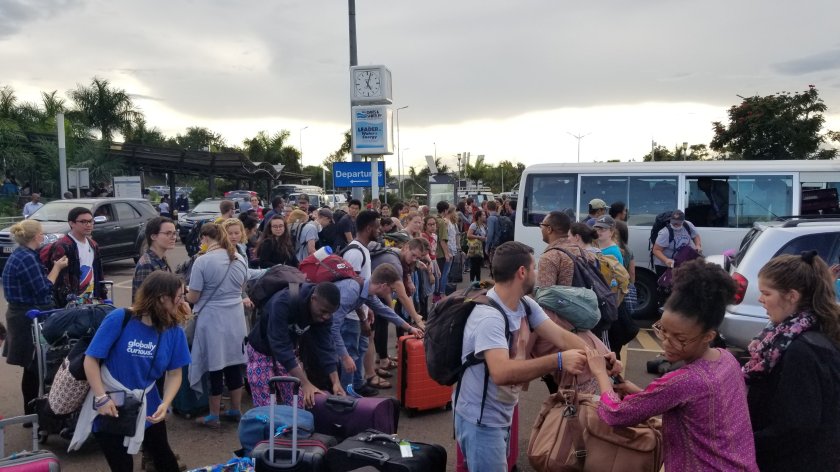
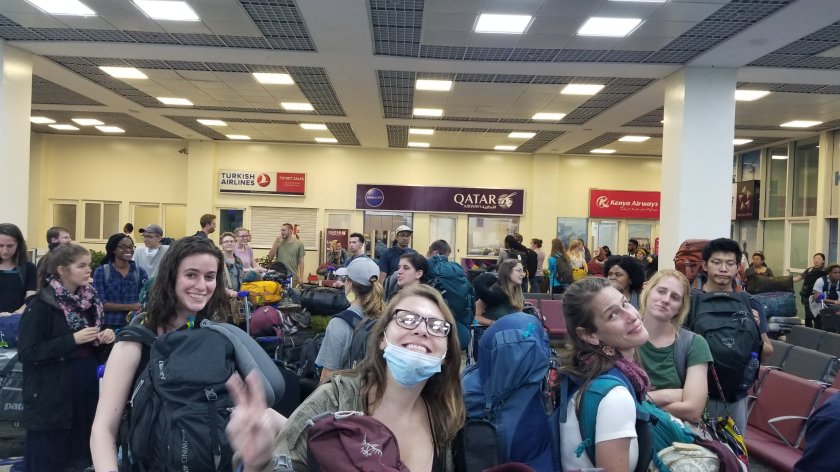
Unloading all of our luggage in the Kigali airport parking lot. More unloading. Me and my friends waiting in line at the Kigali Airport. Left to right: Dani, Bri, Austin, Robyn, Darren.
Evacuation happened so quickly.
There are 700 volunteers in Peace Corps Africa who needed to get home, which became increasingly more and more challenging as borders were closing and flights became more limited. As the situation became more dire, commercial flights were no longer an option and Peace Corps chartered flights for us.
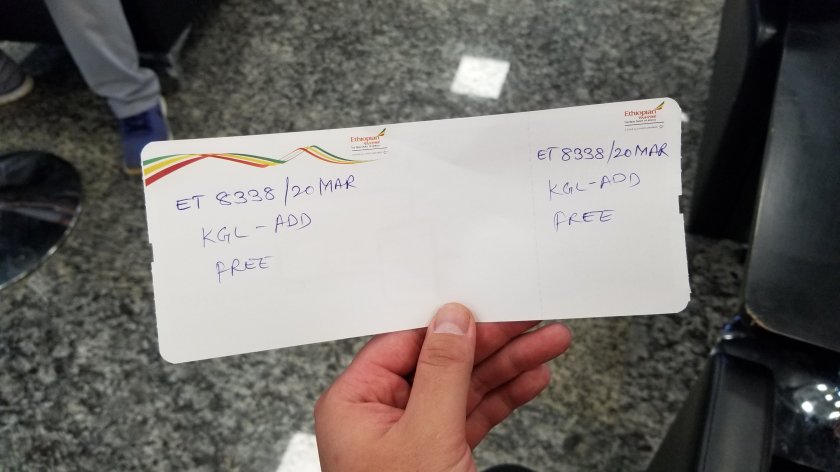
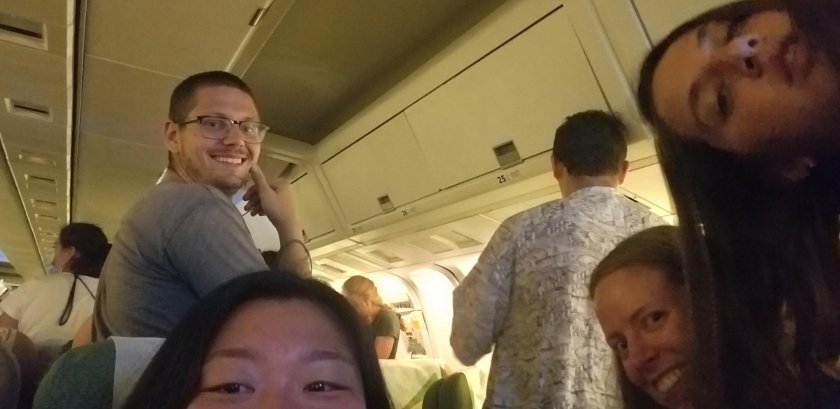
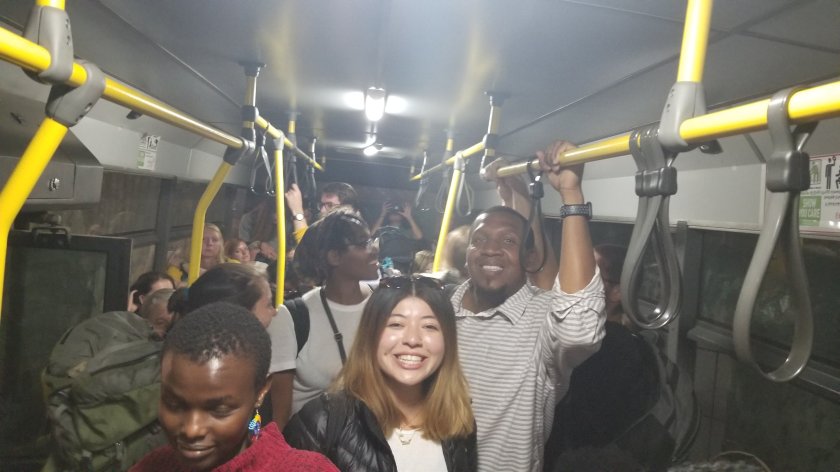
I thought this was hilarious. This is our ticket from Kigali to Ethiopia on our chartered flight. Our chartered flight did not obey regular airplane rules. It was half empty and filled with only PC Volunteers, so we walked around the cabin, drank duty-free wine, and had fun. Left to right: Garret, me, Erin, Brooke. On the bus from our hotel in Ethiopia to the Airport. Left to right: Clem, Sierra, Leia, Jerrion.
PC Rwanda was evacuated Friday night with a chartered plane, merely hours before the country shut its borders. We were “picked up” by PC Uganda, and together we went to get PC Malawi before going to Ethiopia. Addis Ababa was the meeting point for all of Peace Corps Africa to be evacuated to America. We arrived at ~5am and were on another chartered flight with PC Ethiopia, Zambia, Mozambique, Cameroon, Malawi, and Madagascar at 1a the next day/night. I have to say, it was fun meeting the other volunteers and exchanging stories about our countries. I wish It had been under different circumstances, but as we say in Rwanda, “bibaho” or “it happens.”
The evacuation has been a very stressful time for everyone. We’d get emails notifying us if we’d be on a flight that day, be on standby, or wait another day to be evacuated. We were always on our toes, ready to move, and so caught up with the entire evacuation process that it never occurred to us that these would be our last moments together. With everything that’s been going on, it didn’t even occur to me that I’d have to say goodbye to everyone. My friends and I enjoyed one, final night together in DC before we all fly out to our respective homes in the morning. It’s sad that this is how our stories end.
With that, it looks like my Peace Corps service has come to its final moments. Thank you all for joining me on this adventure; it was a pleasure to share it with you.
Evacuation Timeline
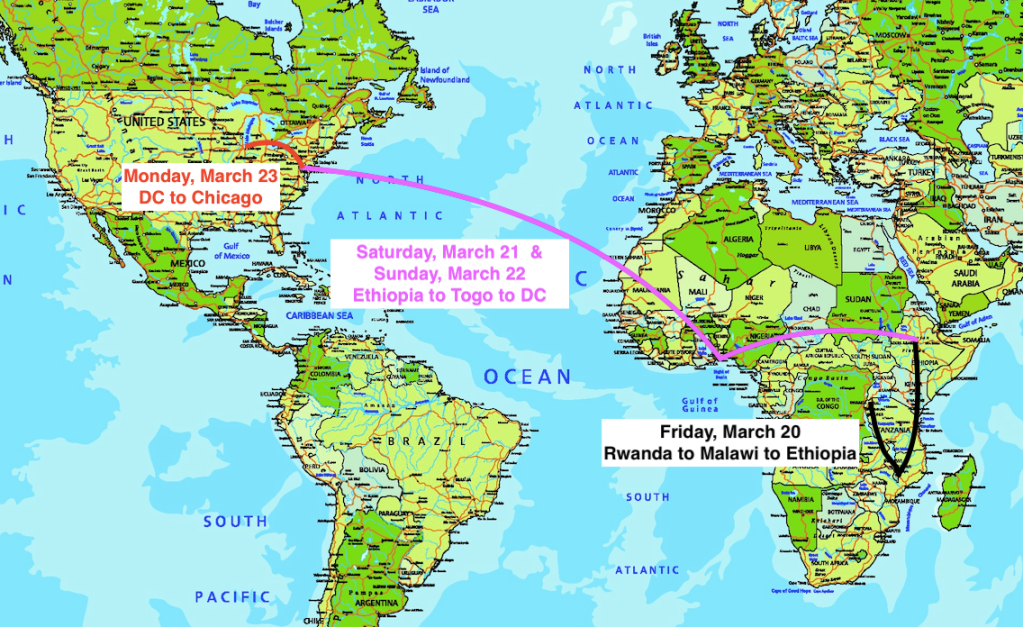
A map of my evacuation/ travel timeline.
Monday – Email from our Country Director that we will be evacuating
Thursday – Left site
Friday – Flight from Rwanda to Malawi to Ethiopia
Saturday – Flight to DC from Ethiopia, refueled in Togo
Before coming here, I knew having both running water and electricity were slim. I have electricity, but no running water. I didn’t have electricity during my first month, which was challenging, especially when the sun sets everyday at 6:30p.
Water is another problem. As volunteers, we’re always so curious to know what other people’s “water situations” are. Who has a spigot? Is it in their house? Outside? In the village? The lucky ones have one in their house, the not so lucky ones have to walk up/down a hill to fetch water or hire someone to get it for them.
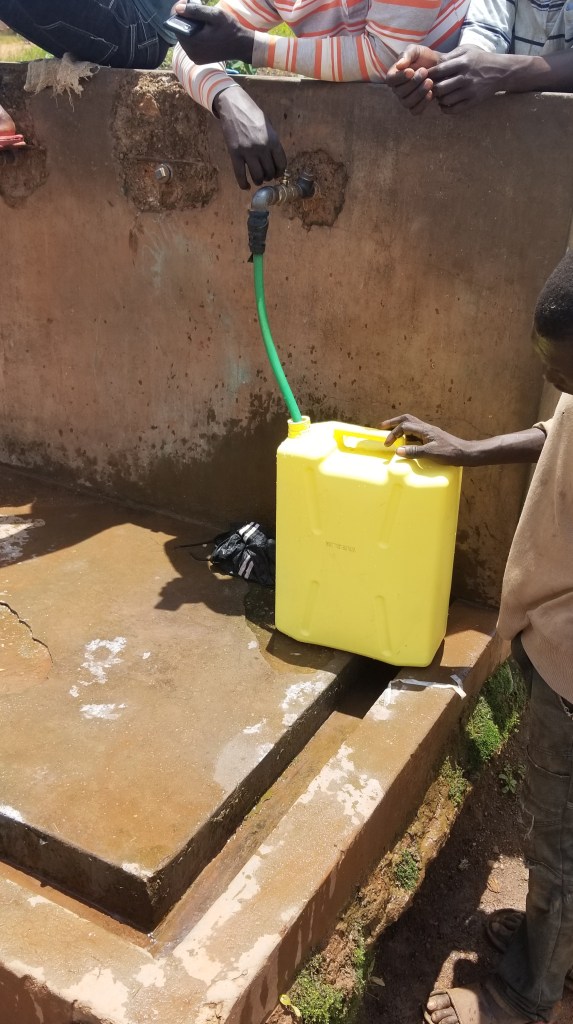
Like the locals here, I use jerry cans to transport and store my water. They can hold 20L and weigh 44 lbs when full. It’s physically exhausting to transport water to my house, but luckily, the spigot is only 50m meters away and downhill when walking back home.
Filling up my jerry can at the local spigot!
So, how much does water cost here? It depends on where you live in Rwanda. Some of my friends have to pay 100-200 RWF for a full jerry can, which is roughly $.10 – .20 USD. However, when it’s the dry season it can get up to 1000 RWF (~$1 USD). I think I lucked out, because mine is only 30 RWF per can, which is only $.30. My dad joked that he’d cover my monthly water bill by sending me $3.00, which would get me 10 jerry cans!
Though the water is cheap through our American lens, it can be quite expensive for Rwandan families. Before coming here, we were told that cleanliness and hygiene is one of the most valued aspects of the culture. I never understood why until I went into the village life where I can see how water insecurity separates social classes. When water was scarce, I sacrificed my personal hygiene. I didn’t wash my clothes, I didn’t shower every day, and you could tell. I was disgusting. Not having a reliable source of water, especially during the dry season, took a huge psychological toll on me. I’m not religious, but I would pray for rain so I could collect rainwater off of my roof. I often find myself stressing out about how to ration it – do I wash dishes, clean my clothes/shoes, wash my hands, brush my teeth, shower? I never thought I’d sacrifice hygiene to the extent that I have, but here we are. Without a second thought, I prioritized my water to drink and cook. I even starting thinking of ways to change my lifestyle so I would use less water, for example, I tried finding ways to make food that required the least amount of dishes to wash, working out less so I wouldn’t have to shower, eating from the pan so I wouldn’t have to wash a plate, etc. On top of all of that, I’d recycle the water I used to do laundry and wash my dishes and vegetables with so I can flush my toilet. (I have a flushing toilet, but no running water).
I can see how water scarcity affects the families here – their clothes and shoes are dirty and smelly. They don’t have good hygiene. Having access to water is one of the most defining determinants of social class. The huge emphasis on cleanliness is a result of that.
 Rwandering around with Joanna