This past week has been very busy in the Southern Province, especially at my health center (HC). Every year, the government encourages families to have the inside walls of their homes sprayed with pesticides to kill mosquitos to reduce malaria. Indoor Residual Spraying (IRS) is a coating on walls that can last several months and can kill mosquitoes when they come into contact with it. It doesn’t directly prevent malaria, but prevents it from spreading. My HC has been used as a base by the government officials who are leading our Community Health Workers (CHWs) to spray homes in the 7 villages our HC serves. It’s especially important that IRS is implemented in Huye, my district, since it has one of the highest rates of malaria in the country!
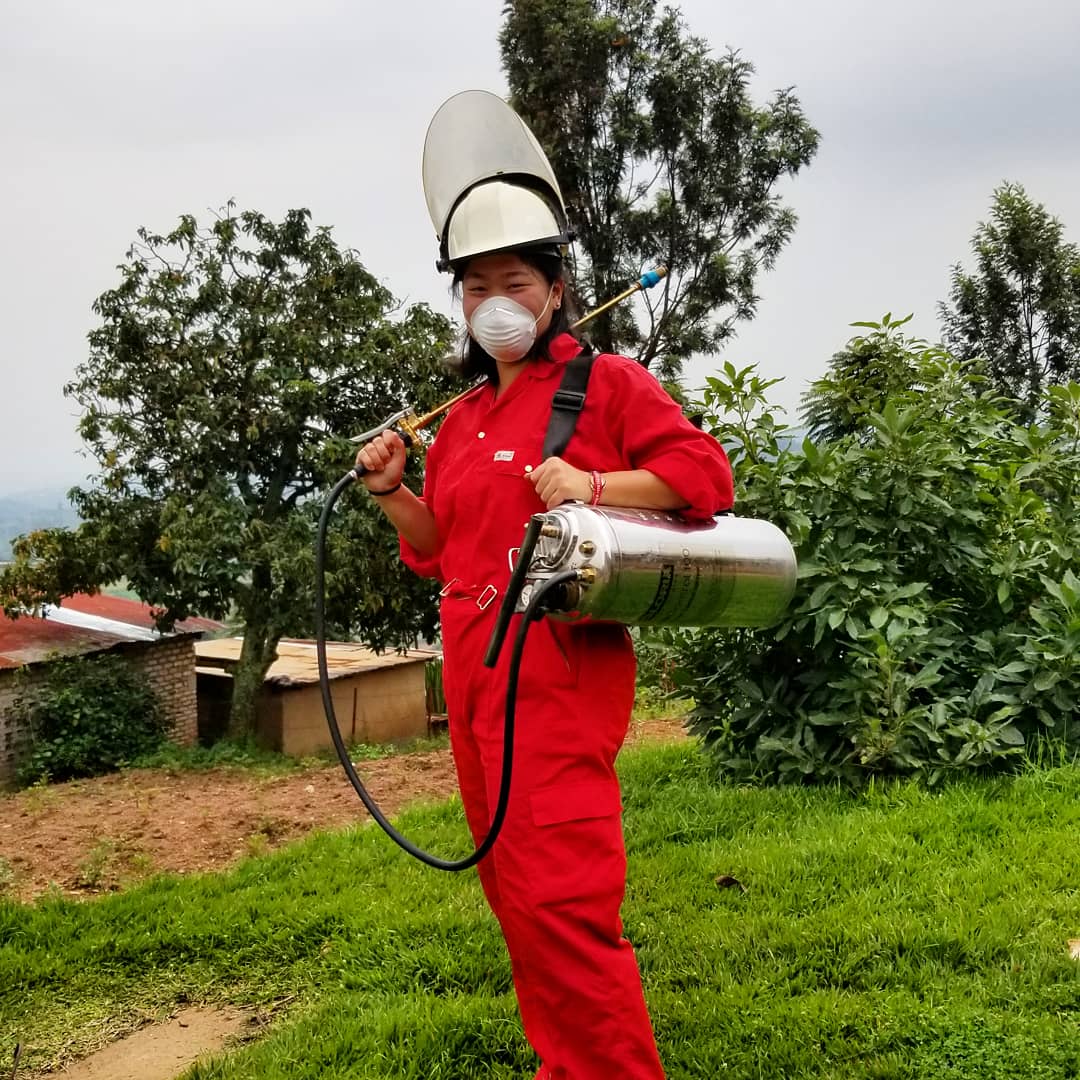
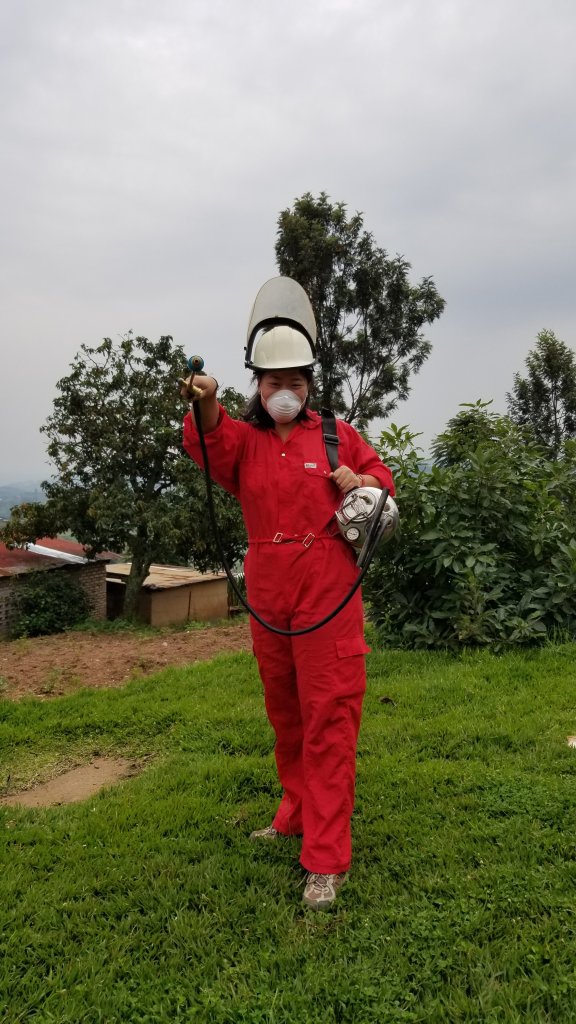
Geared up like a spray operator!
That being said, I wanted to jump in on the action! I asked the woman leading the IRS operation and she allowed me to join her in the field with the CHWs. When talking to everyone about it, I learned that a lot of Rwandans are very resistant to IRS. I was confused because it’s paid for by the government and it reduces everyone’s chance of getting malaria, seems like a win-win to me! But I learned that it’s very inconvenient moving all of your belongings outside while the spraying happens, strangers would see the inside of your house and all of your belongings, the pesticide smells and gives people headaches, and above all, there’s a lack of education etc. It’s also the rainy season right now (I haven’t seen the sun since Sunday afternoon), and when everything has to be moved outside for several hours, the rain discourages IRS. It’s an uphill battle, but even if we spray one house, it’s a big difference for that one family.
Malaria Fast Facts:
It’s a preventable disease
It’s responsible for 10,000 maternal and 200,000 infant deaths worldwide
It can be treated properly when diagnosed quickly with a blood test
Here’s a funny story about my name and how I got my Rwandan one.
This happened a few months ago, but I think it’s a funny story worth sharing.
In Rwandan culture, it’s common for people to refer to you by your last name. A lot of the Rwandan teachers and PC staff often called me Kim or Kim Jo. When I first met my host brother, who was home briefly from Medical School, we had a fun conversation that went like this:
Me: Hey, I’m Joanna Kim, but a lot of people call me Jo.
Him: Hey! Ah, Kim, you must be Korean. The home of Samsung.
Me: Yes, wow, how did you know? (I was so impressed!)
Him: A lot of people from Korea have that last name. Hm, Kim, Kim Jo. Kim Jo. Hey, do you know Kim Jung Un?
Me: …
Him: I like his haircut.
Funny, right?! I’ve never had a conversation like that before, especially since nobody has ever compared our names like that. I hope it brings a smile to your face as it did to mine. It happened months ago and I still laugh about it!
On the topic of names, my host mother gave me a Rwandan name. Peace Corps recommended our host families to give us Rwandan names, especially if our American ones are difficult to pronounce, to help us integrate. On my second day with my host family, my host mom said that she would call me Keza (keh-zah). Names are an important part of Rwandan culture, there’s even a traditional naming ceremony for newborns where people offer names that reflect them or have a significant meaning behind the name. So, I asked my host mom, “what does Keza mean?” She said, “beautiful.”
I was embarrassed when she told me that. I never thought of myself as beautiful or ever being called that. Hopefully, I’ll grow into it.
We are a few days away from being a full month at site and I’m starting to settle into my new home and community in Huye. I figured that you are all very curious to know more about what my life is like here.
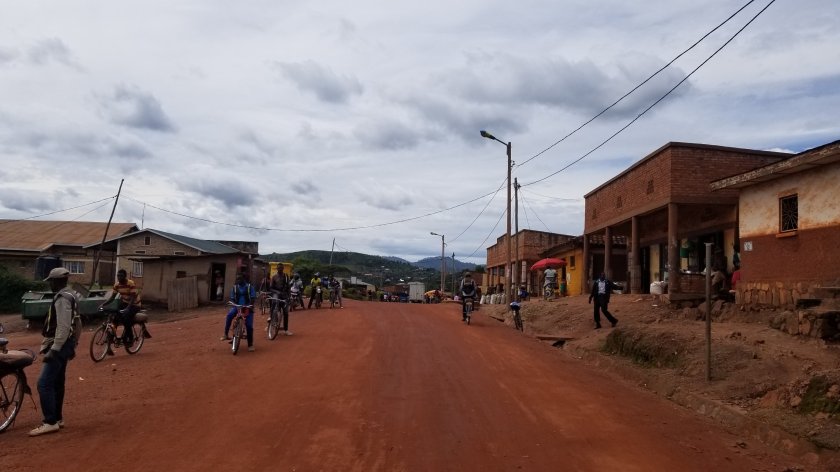
First thing’s first, I’m really lucky to be placed where I am. My site is very urban compared to other sites. The market next to my Health Center is open everyday. Some volunteers have markets open only every Thursday and Sunday, which can be anywhere from a 10-90 minute walk or a 20-45 minute bus/moto ride away. I also live in the “downtown” area of my village, which has small stores (boutiques) for snacks, toilet paper, and random things that all Rwandan boutiques seem to have.
The main road that my house, heath center, market, and stores are on.
Furthermore, I live ~3 miles from the third largest city in the country, Butare. The walk is also very flat, which is very lucky since we’re in the land of a 1,000 hills. The market in Butare has EVERYTHING – clothes, home appliances, restaurants, etc. It also helps that Butare is a “college” town, so there are a lot of coffee shops, bars, and even clubs in the area. I was initially really disappointed that my site was so urban and I’d be missing out on the “proper” Peace Corps experience of being in a very rural and isolated area. However, the volunteer who I am replacing asked me something that I haven’t forgotten, ‘why make life harder than it already is by being in an isolated site?’ He was right. Life here is difficult as it is, why would I want to make it more difficult for myself by having a market only twice a week, difficult to get to, and has a limited variety of food? One of my closest friends (emotionally, not geographically) told me that her market is only twice a week, open from 5-6:30p, and almost always has only potatoes and rarely anything else. That sounds really difficult to endure for two years. Having a big market nearby has definitely made life easier for me and made turning my new home into a home.
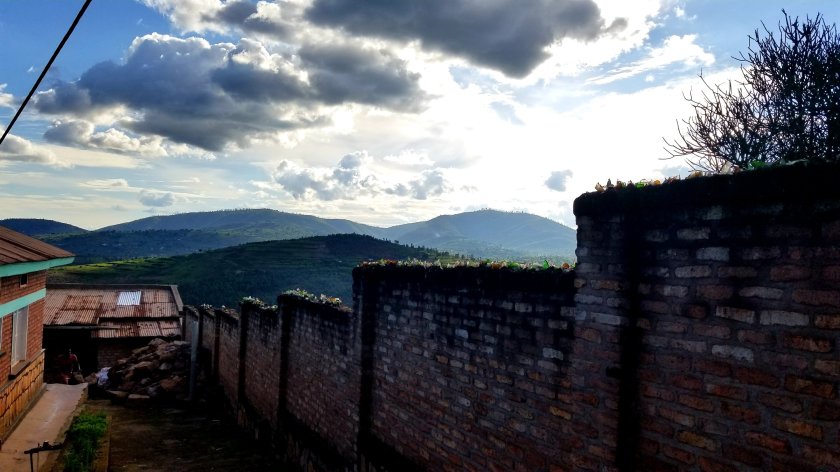
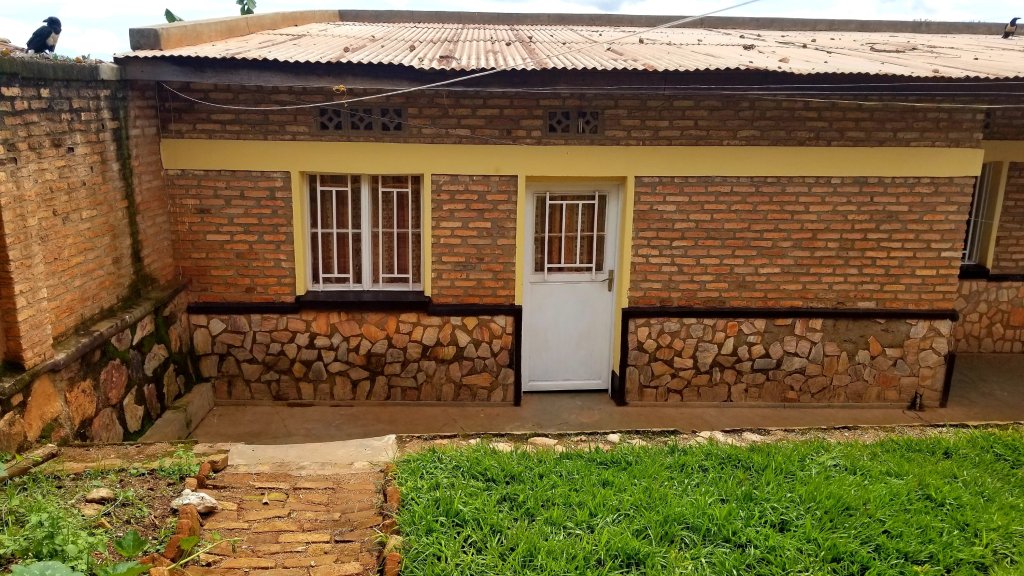
You’ll see this beautiful view when you walk through the gates of my compound. This is the front of my house! It’s a cute and small space in the corner of the compound. I have two other families in the compound, which makes it feel very safe!
Unlike other health volunteers, I don’t live on the Health Center property. I live ~500 feet down the road from the Health Center in a compound with two other families. My house feels very safe and I actually share a wall with the lab tech and her family! Peace Corps is very strict about where they house volunteers since safety is very important (I know my parents very relieved to hear this).
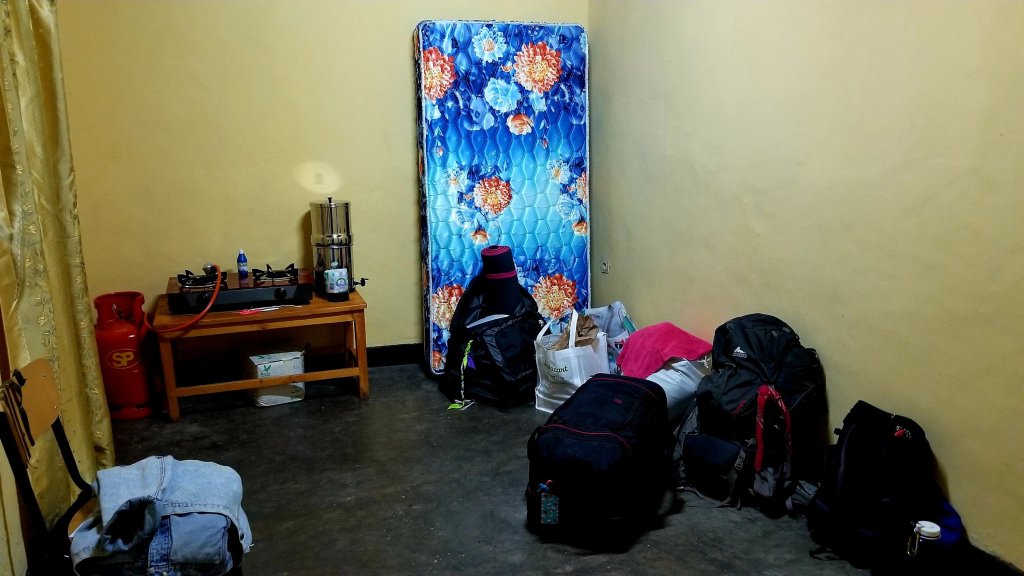
There is a lot of variation in the types of houses for us in Rwanda. Some homes are quite large, with multiple spacious rooms, while others are quite small. Since my site is very urban, I have an appropriately sized house. It’s small, maybe 500 ft^2. It’s the size of a perfect square, divided in half into two rooms – one is the living room and kitchen (photo below) and the other is my bedroom. I also have a small indoor bathroom, which is very lucky. I currently don’t have running water, but I have electricity in one room (sometimes).
I took this photo the first day I moved in. In this photo, going from left to right, is a table and chair my HC lent me, a gas stove, water filter, my mattress and all of my stuff – clothes, gear, food etc.
The photo above shows the saddest state my house has been in. It was so bare, but now I have a carpet, another table, and a bed frame. For nearly a month I did everything on the floor – slept, ate, cooked. It has been a slow and steady process. On Christmas Eve, my bed frame came and today I got another table and a shelf to put all my clothes on. I’ll be sure to send a housing update once things become more complete. In all honesty, I’m just happy to have furniture! More and more things are moving off the floor!!
 Rwandering around with Joanna